Meaning of Numbers: The Number 13
The English word "thirteen" for the number 13 is recorded 15 times in 15 King James Old Testament verses. The word "thirteenth" is found 11 times in 11 Old Testament verses. Combined, they appear 26 times in 26 verses in the King James Bible. Both "thirteen" and "thirteenth" do not appear in the New Testament.
Both words that designate 13 are recorded the most in the book of Esther (6 times) followed by both Joshua and 1Chronicles (5 each) and then the book of Numbers (4).
The number 13 is symbolic of rebellion and lawlessness in the Bible. Nimrod, the mighty hunter who was "before the Lord" (meaning he tried to take the place of God, Genesis 10:9), was generation 13 in Ham's line (Ham was one of Noah's three sons who survived the flood).
13 represents all the governments created by men, and inspired by Satan, in outright rebellion against the Eternal.
Appearances of the Number Thirteen
The longest name of a book, Thessalonians, is 13 characters long.
In Romans 1 the apostle Paul lists 23 characteristics of sinful people who have a debased or reprobate mind. The thirteenth characteristic is that they are haters of God (Romans 1:28 - 32).
The destruction of Jericho is stamped with the number 13, for the city was marched around for six straight days, and on the seventh day, it was marched seven times, making thirteen total.
King Solomon spent a little more than seven years building Jerusalem's temple, God's house of prayer for the nations (1Kings 6:38). In contrast, He spent thirteen years building a home for himself!
But Solomon was building his own house thirteen years, and he finished all his house (1Kings 7:1, KJV).
There are at least 13 famines mentioned in the Bible (Genesis 12:10, 26:1, 41:54, Ruth 1:1, 2Samuel 21:1, 1Kings 18:1, 2Kings 4:38, 7:4, 25:3, Nehemiah 5:3, Jeremiah 14:1, Luke 15:14 and Acts 11:28.
In Mark 7 Jesus mentions thirteen things that defile a person. They are adulteries, fornications, evil thoughts, murders, covetousness, thefts, wickedness, licentiousness, guile, blasphemy, foolishness, pride and an evil eye (Mark 7:20 - 23).
Parables and 13
Which New Testament chapter has the highest concentration of parables from Jesus? The answer is Matthew 13 which records eight of them!
The first four parables of Jesus in Matthew 13 are the Sower (verses 3 - 23), the tares (24 - 30), the mustard seed (31 - 32) and hidden leaven (verse 33). The last four are treasure hidden in a field (verse 44), the pearl of great price (45 - 46), the Kingdom of God is like a net (47 - 50) and the householder (verse 52).
Interestingly, six of Matthew 13's eight parables are unique to his gospel!
The greatest concentration, time-wise, of parables given by Jesus is 14 from Mid-November to Mid-December in 29 A.D. Second place is 13 taught from January to February in 30 A.D.
Chronologically, the 13th parable given by Jesus is that wisdom is justified by her children. He gave this parable in the summer of 28 A.D.
"The Son of man came eating and drinking, and they say, 'Behold, a man who is a glutton and a winebibber, a friend of tax collectors and sinners.' But wisdom is justified by her children." (Matthew 11:19, HBFV, see also Luke 7:35).
The Number of Evil
The English word "Hinnom" occurs in 13 times in 11 King James verses. The valley of Hinnom was the scene of the evil-inspired rites of the pagan god Moloch (or Molech).
The practices related to the false deity Molech received some credibility when they were knowingly allowed by King Solomon (1Kings 11:7) to please his non-Israelite wives.
And they have built the high places of Tophet, which is in the valley of the son of Hinnom, to burn their sons and their daughters in the fire; which I commanded them not, neither came it into my heart (Jeremiah 7:31, KJV).
And they built the high places of Baal, which are in the valley of the son of Hinnom, to cause their sons and their daughters to pass through the fire unto Molech; which I commanded them not, neither came it into my mind, that they should do this abomination, to cause Judah to sin (Jeremiah 32:35, KJV).
One of the several ways Molech was appeased and worshipped was through the sacrifice of children who, placed on the red-hot arms of the idol, were burned alive. The valley's tie to fire made for an apt backdrop of the ultimate punishment unrepentant and rebellious sinners will receive in the lake of fire (Revelation 19:20, 20:9 - 10, 14 - 15).
The Greek word drakon, Strong's Concordance #G1404, occurs 13 times in 12 Greek New Testament verses. The word is used only in the book of Revelation. It is always translated as the word "dragon," a symbolic reference to God's adversary Satan the devil.
And the great dragon (drakon) was cast out, that old serpent, called the Devil, and Satan, which deceiveth the whole world: he was cast out into the earth, and his angels were cast out with him (Revelation 12:9, KJV).
And they worshipped the dragon (drakon) which gave power unto the beast: and they worshipped the beast, saying, Who is like unto the beast? who is able to make war with him? (Revelation 13:4, KJV).
Number 13 and God's Character
Moses had to hew out a second set of tablets for the Ten Commandments after the first was broken due to Israel's sins (Exodus 34:1).
Carrying the new set of tablets, Moses went up Mount Sinai to have God inscribe his laws a second time. The Lord's presence then enveloped him like a cloud and, according to Jewish tradition (the Middot), proclaimed 13 forms of His mercy. These 13 holy attributes, taken from Exodus 34:6 - 7, are the following.
1) Compassion before a person sins.
2) Compassion after a person has sinned.
3) Mighty in compassion to give all creatures according to their need.
4) Offering mercy that humans may not be distressed.
5) Being gracious if humans are already in distress.
6) Slow to anger.
7) Plenteous in mercy.
8) Abundant in truth.
9) Keeping mercy unto thousands.
10) Forgiving iniquity.
11) Forgiving transgression.
12) Forgiving sin.
13) Willingness to pardon.
Esther and Thirteen
Haman the Agagite, because of his utter dislike of the Jews, convinces King Ahasuerus that they should all be murdered within the Persian Empire. His zeal is such that he is willing to pay the king 10,000 talents of silver (Esther 3:9) which, assuming a modern price of $50 per troy ounce, would be worth $547 million dollars today!
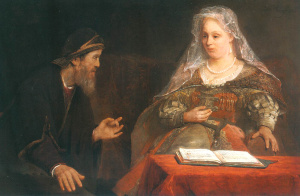
Haman has an edict written on Nisan 13 (first month of Biblical sacred year, Esther 3:12) that on Adar 13 (a day Haman considered lucky) all Jews should be murdered!
In the first month, that is, the month Nisan, in the twelfth year of king Ahasuerus, they cast Pur, that is, the lot, before Haman from day to day, and from month to month, to the twelfth month, that is, the month Adar . . .
And the letters were sent by posts into all the king's provinces, to destroy, to kill, and to cause to perish, all Jews, both young and old, little children and women, in one day, even upon the thirteenth day of the twelfth month, which is the month Adar, and to take the spoil of them for a prey. (Esther 3:7, 13. KJV).
Esther and Mordecai, however, foil Haman's plans. Haman is ultimately hanged on the same gallows built to hang Mordecai (Esther 7:10). Queen Esther then arranges a new edict to be sent around the empire authorizing Jews to defend themselves on Adar 13.
The Jews gathered themselves in their cities throughout all the provinces of King Ahasuerus, in order to lay hands on any who sought their harm. And no man could withstand them, for the fear of them fell upon all people.
And all the rulers of the provinces, and the lieutenants and the governors and officers of the king helped the Jews, because the fear of Mordecai had fallen upon them (Esther 9:2 - 3, HBFV).
This dramatic saving of the Jews from exterminated is commemorated every year in the holiday of Purim which is observed on Adar 14.
Apostle Paul's Evangelism
The Apostle Paul started nine known churches (Pisidian Antioch, Iconium, Lystra, Derbe, Philippi, Thessalonica, Berea, Corinth and Ephesus). He also highly likely founded fellowships in Tarsus, Athens, Cenchrea and Troas for a total of thirteen Christian churches.
More Info on Biblical Meaning of 13
There are 147 words and phrases in the Bible's original languages that are recorded exactly 13 times.
The Greek word chrusos, Strong's Concordance #G5557, occurs 13 times in 12 Greek New Testament verses. It is found the most in the book of Matthew (5 times) followed by Revelation (4). The word, in the King James, is always translated as gold.
And the merchants of the earth shall weep and mourn over her (the end time Babylon the Great which rules the world); for no man buyeth their merchandise any more:
The merchandise of gold (chrusos), and silver, and precious stones, and of pearls, and fine linen, and purple, and silk, and scarlet . . . (Revelation 18:11 - 12, KJV).
The earliest start, throughout history, of Passover occurring is at sunset on March 13. This early observance of the first of God's annual Holy (Feast) days takes place in the years 1348, 1405, 1481, 1500 and 1576 A.D.
Ishmael, the first physical son of Abraham (through Hagar), was circumcised (which is cutting off the foreskin of a penis) when he was 13 years old (Genesis 17:25) as part of the then new covenant God made with Abraham (Genesis 17:1 - 22). This, however, was just the start.
Abraham also had every male born in his house (at least 318 individuals - Genesis 14:14), as well as all the males he owned, and any other males (whether an adult or child) he was responsible for, circumcised on the same day (Genesis 17:23 - 27)! In addition, even though he was 99 years old, Abraham himself submitted to circumcision.
In the Old Testament, the Biblical chapters of Psalm 79, 85, 96, 108, 140, Song of Solomon 6, 7, Isaiah 6, 27, 46, 55, Jeremiah 43, Daniel 12, Amos 4, Micah 2, 4, Nahum 2 and Zechariah 2 contain 13 verses in the King James translation.
In the New Testament, 1Corinthians 5, 8, 13, 1Thessalonians 3, Hebrews 8, 2John 1 and Revelation 8 all contain 13 verses in the KJV.
The books of 2Corinthians and Hebrews, both written by the Apostle Paul, have 13 chapters.